Showing posts with label literature. Show all posts

30.5.12

I May or May Not Have

I may or may not have thrown out some pas de deux moves in the elevator at the end of work on Friday after a stellar interview.
I may or may not have given up on the notion that I could always have an organized purse. 
I may or may not have Red Ginger Sushi on speed dial. 
I may or may not have underestimated the effect of gravity upon canon-balling into the shallow end of a pool. somehow, I am okay today.
I may not have had a valid enough reason to keep me from shopping at city creek during my lunch breaks. 
I may or may not have finished an entire gallon of samoas cookie ice cream.
I may or may not have registered to vote this week.
I may or may not be blogging when I should be sleeping. 

© 2012 by Rachel Lowry. All rights reserved. {photo via}

15.3.12

Book Review: Tess of the D'urbervilles


Reading Thomas Hardy's Tess of the D'urbervilles has been endearing and captivating in its heart-wrenching fatalism. The novel, which is now considered a major nineteenth-century English novel, tells the tale of a young Tess D'urberville, in an impoverished rural England during the Depression in the 1870s. Her yearning to achieve status will lead to questions of what is entailed in purity and innocence. 

Hardy's panorama views of the Blackmore Vales of the English Countryside are most arresting, as is our heroine's tenacity, in her unwarranted desperation. How daunting are those dimly-fixed suggestions that give the reader pause to wonder if  existence itself can be nothing more than a roll of the dice.
The narrator asks, "But, might some say, where was Tess's guardian angel? Where was the Providence of her simple faith? Perhaps, like that other god of whom the ironical Tishbite spoke, he was talking, or he was pursuing, or he was in a journey, or he was sleeping and not to be awakened."
I yearned to run to her side, to answer as her guardian angel, if none she had. How I wondered how Hardy could do it, could commit the most sadistic, the most unprincipled of acts in permanent ink. What a beautiful, beautiful tragedy.

@ 2012 by Rachel Lowry. All Rights Reserved

24.10.11

Monday Quote

We are not now that strength which in old days moved earth and heaven; that which we are, we are;
One equal temper of heroic hearts, made weak by time and fate, but strong in will. To strive, to seek, to find, and not to yield.

Ulysses, Lord Tennyson

25.8.11

little letters series: oh my homegirl, just once more


I amuse myself in entertaining the question as to which of us is who, as I can’t help but find parallels between that of the momentary closure of the great Sherlock Holmes and his loyal companion Dr. Watson, and you and I: 


Two persons, sisters, both in blood and in bond. Unable to resist a touch of the dramatic, they rampage the streets by night, caught up in the unveiling of endlessly vile heists of all measures and classifications {theme music a necessity}.

They are to one another a sounding board, a confidante, a keeper of secrets. They are the closest connection to the other’s identity, fellow schemers, as close as two sisters could be. They are to other the closest adviser, teacher, and a most effective chearer-upper. They are the other a most avid defense attorney, a shrink, if you will. They are the greatest partners in crime the world has yet to see, the most astute of midnight companions. They know when the other is smiling, even in the dark. It is with one another they share their imaginary worlds and endlessly absurd and ridiculous fictional creations concocted in the dead of night. They fight with and for each other. It is with one another that they spill their unguarded thoughts, breathing the hidden yearnings that the world is too large to understand. It has always been these two who have pulled one another {and sometimes joined one another in} the deep water they often find themselves in, to make the other laugh so hard she can't breathe and sing so loud she’s lost her voice. They have a history of co-conspiracies and stealthy getaways that have the most notorious of contendors scratching their chins.

But now they must part, move on, let go, knowing full well each will be leaving a thin heartstring, a part of oneself with the other no matter the distance between them. All it took was one summer; one summer and forever would become something real, something worth fighting for, something of a whisper behind their everyday soliloquies. It may have had everything or nothing to do with the family into which they were born, but it was within that family that they were given the rare opportunity to know and be known by one who shares blood and body, history and dreams, common ground, the unknown adventures of the future, darkest secrets and the glassiest beads of truth.

As you run headlong into college life, I know you will come a bit closer to finding out what it means to be Mckenzie Rae Lowry. I can’t wait to hear about it all and see how you will grow, how you will change. However, there are some attributes I hope never change, no matter where you go.

Never lose that look in your eye when you’ve struck a great idea – how you hold it for a while, letting it hang in the air until I can’t take it anymore and have to know. Never lose your impeccably lethal need to experience it all, at the cost of sleep, health and reason. Never lose those whimsical freckles of yours that I so envy. Never lose that moment you look in the mirror before you head out, knowing you look good – I mean really good – comprehending at the very smallest degree, how absolutely lovely you are. Never lose your power of deduction and love of learning. Never lose sight of the fact that the horizons of your dreams are endless. Never stop begging someone, anyone, to stay up late to whisper French phrases or act out novel scenes. Never give up on those dreams you hold so closely. You will see Africa; and she will love you. And there is more. So much more. Never lose your ability to understand people – the way you understand me even at my most insane and hormonal of moments. Never stop seeing every spare minute in your life as an invitation for some grand & spontaneous adventure. Never look down – keep your head as high as you always have when the storms of life lash against you. Never lose your acute perfectionism, nor your fierce loyalty. Never stop amazing those around you by your ability to put others above yourself; don’t lose that part of you that cries in ecstasy when giving involves particular inconvenience on your part. And finally, never, never lose your passion for life. It’s what I love most about you.

I know you have in front of you a round of bad Monday mornings, and a heap of really, really good Friday nights. If ever you need to share it with someone, I’m always on the other end of the line or the page or the screen – ready to listen when you just need an ear, to advise when you are in a sticky situation, to remind if you’ve forgotten who you are, or just to exchange the wild stories of your day-to-day goings on when it seems that the distance between us is far too great.

It seems to me that there isn't anything more worth fighting for than that.

And finally, in the beautifully sung words of Mr. Criss, I conclude: I don’t want to see you go, but it’s not forever, not forever. Even if it was you know that I would never let it get me down because you are the part of me that makes me better wherever I go. So I will try not to cry, for no one needs to say goodbye.

I could never love anyone as I love you, my sister,


@ 2011 by Rachel Lowry. All Rights Reserved.

26.4.11

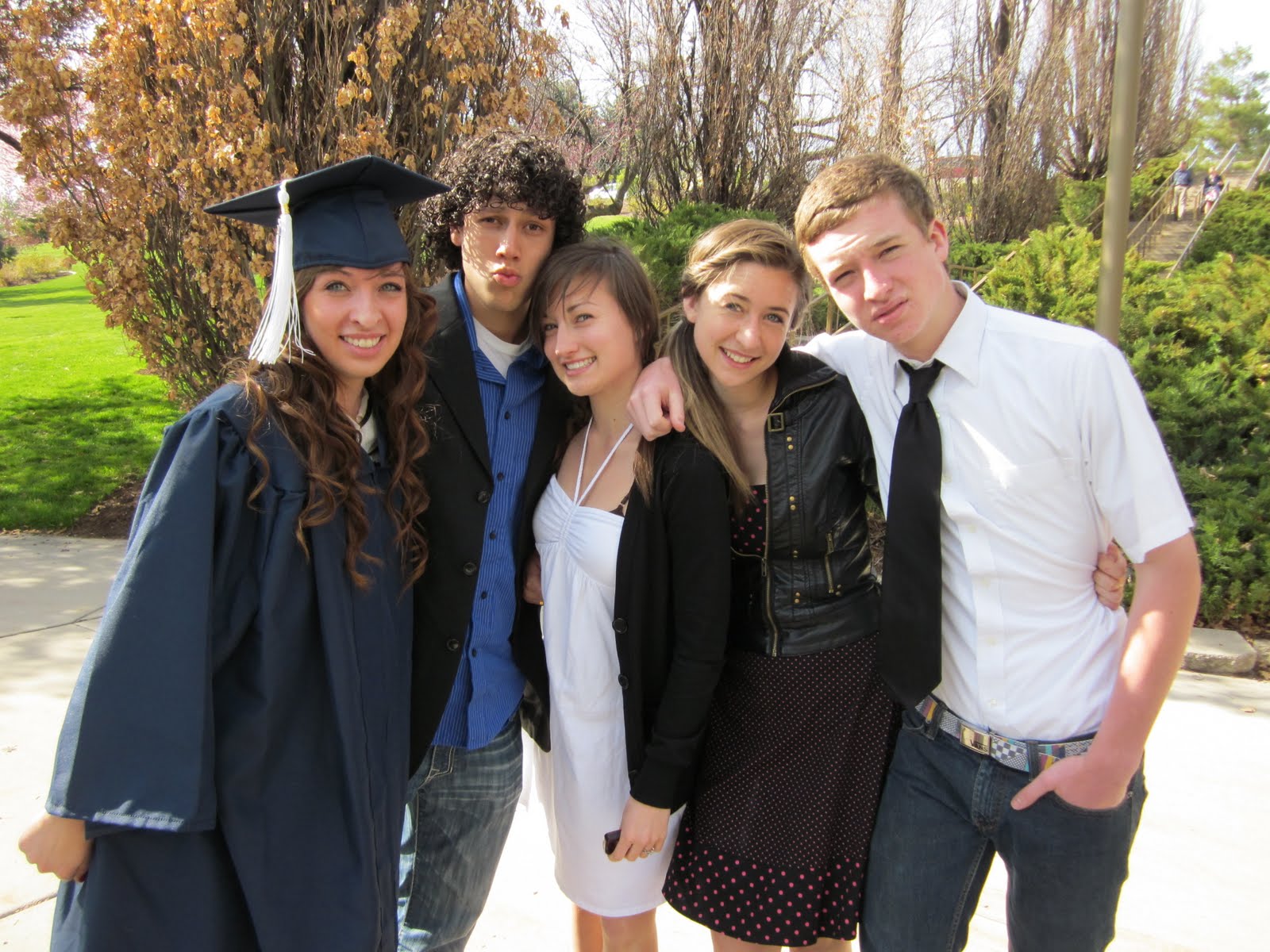
Graduation

I'll be honest. I didn't do the whole thing in an entirely dignified manner. Traffic was bad and work called for some last-minute tasks. I ran across campus in 4-inch stiletto's, humored by the thought of being possibly the first tassel-less graduate at BYU, as the search for the small accessory continued minutes before I was to line up for procession.

And I'll admit, I always thought I'd feel distinguished as I made that walk that demands an heir of unpretentious propriety, an arrived academic. But I really felt like one of many absurd-looking blue penguins, waddling around trying to keep the silly un-balanced, loosely-fitting hats.

The graduation cards and thank you letters for my supporters hadn't been sent, the siblings showed up late, and Grandpa lost his directions to the stadium. But in the end what it all came down to is this:

1. These have been the best four years of my life. I have seen words all my own outside of me on the screen or paper, illuminating that which I thought not possible to articulate fully. I have learned how to come back down to the every day of unvoiced counterpoints, all along finding beauty in the words stripped to their bare meaning.

2. I have an obligation to wield this power of communication for the betterment of others, through truth, trustworthiness and a critical eye as a writer.

3. I am grateful to have been given the rare and fortunate opportunity to be given funding to study at a great school (and abroad) at the cost of hard working and charitable people.

4. I have met great people, been altered forever by their talent and passion for the written word.

© 2011 by Rachel Lowry. All rights Reserved.

16.10.10

we're all mad here


Lewis Carroll’s Alice's Adventures in Wonderland and Through the Looking Glass and What Alice Found There allows us to see the world through the eyes of young Alice – a nonsensical perspective in which we see the absurdities and limitations that culture and language have upon understanding our reality. Shayla S.'s blog, Serendip, plays with this idea in an intriguing way:
Ironically, Alice's Wonderland is nonsensically logical. In Shayla's words, “to prove something is true, the contrary must first be disproven. In the context of nonsense; to show that something is logical, the opposite must be shown to be illogical. Carroll confuses this notion primarily through his word and logic play, illustrating the subjectivity of both truth and reality.” (Shayna S.).
When Alice is drowning in her own tears, she banters with the mouse:
"I had not!" cried the Mouse, sharply and very angrily.
"A knot!" said Alice, always ready to make herself useful, and looking anxiously
about her.
"Oh, do let me help undo it!"
"I shall do nothing of the sort," said the Mouse, getting up and walking away.
"You insult me by talking such nonsense!"

What, really, is nonsensical about this situation? Is it the fact that Alice mis-contextualizes the meaning of certain homophones, or is it the absurdity of a mouse her size telling her to stop doing so?

In her encounter with Humpty Dumpty, Alice questions word meaning:

"When I use a word," Humpty Dumpty said, in rather a scornful tone,
"it means just what I choose it to mean-neither more nor less."
"The question is," said Alice, "whether you can make words mean so many different things."
"The question is," said Humpty Dumpty, "which is to be master-that's all."

“Why should Alice reject Humpty Dumpty's authority to make up meanings whenever he desires? There is an established, official rulebook on the definitions of words (at least those that have been agreed upon to be recognized as words). To think that anyone can assign new and multiple meanings to words is illogical because we have the conception that she is unauthorized to do so. But who is authorized to write the dictionary? Oxford? Who is the (wo)man (or men or women or people) behind the curtain? Definitions of words are not entities in which we can rely on not to change. Many words completely transform from the original meaning into something entirely different. Here the nonsense of making a word be whatever one chooses lies within the notion that Alice and the reader believe language and grammar are fixed systems. Alice, like the reader, must draw herself away from her "normal" Victorian expectations and learn to accept the absurd as the new norm” (Shayla S.).
“For us, recognizing nonsense is an important part in our construction of our reality. Understanding what something is not alternatively adds to the understanding of what something is. It allows one to question the solidity of our definitions of things,of ourselves, and of the reliability of experience as a foundation of the sensible” (Shayla S.).

Through Alice’s changing assumptions, the reader is led to wonder, how fluid is our reality?

"She ate a little bit, and said anxiously to herself "Which way? Which way?" holding her hand on the top of her head to feel which way it was growing, and she was quite surprised to find that she remained the same size: to be sure, this is what generally happens when one eats cake; but Alice had got so much out-of-the-way things to happen, that it seemed quite dull and stupid for life to go on in the common way."

As a child, Alice is not yet limited by the dimensions that culture dictates. For Alice, hazy is the line between fact and fiction, between history and fanctasy, between rationality and imagination. For Alice, words can mean whatsoever the user chooses them to men, an idea contrary to traditional education. There lies within such an idea something extremely liberating-something I fear we lose grasp of as we grow up. In a way, I'm jealous of Alice. What I wouldn't give to go behind those bright blue eyes for a moment, to see the world in absolute wonder and curiosity, to be liberated from the confinement that the human-construction of words so often have upon our understanding and thought-process. In a very peculiar way, nonsense tells us more about ourselves than sense ever could.

@ 2012 by Rachel Lowry. All Rights Reserved.

21.2.09

The Empty Spaces


I love the places that hold books. I love meandering within a library or bookshop containing shelves and shelves of books, spread out before me like a vast, bottomless sea. I love that I feel encircled by the writers themselves, my fellow colleagues, my silently declare confidantes. I love the way each aisle is a capsule to other worlds, new thoughts, old ideas. I love the way each book is pressed against the next, linked in a comradeship of thought.

I love the physicality of books. I love turning a page, which marks the progression of understanding. I love handling the aged spines of those written centuries before me. I love fingering the sharp-edged books of modern writers, listening as they relate to me what they have to make of the world. I love thumbing through the chapters, catching the deep scent that I associate with a book. It gives each book its individual character. I love the dusty, musty scent of the old ones; and I love the crisply fresh scent of the pages just off the press.

I love the empty spaces within my books. I love adding to them. I love interacting with them. I could have nothing more to add to some of these works but that which, by the dictates of my own fancy, breathes in and out of me as I whisper the words aloud. I love how the words can become a part of me, how each story, each argument, each confession becomes an addition to who I am. I love that, between those bold printed words, there can be found in quickly pressed ink, my ever-present interaction with the text. I love that.

@ 2011 by Rachel Lowry. All Rights Reserved {photo via: imgwhoop}  

9.2.09

Book Review: The Hours


A stunning British-American drama film with nine Academy Award nominations, Stephen Daldry's The Hours is a story of three women from different eras and places, connected by their yearnings for meaningful lives.

The film is an adaptation of Michael Cunningham's Pulitzer Prize-winning novel, which draws inventively on the life and work of Virginia Woolf to tell the story of three contemporary characters wrestling with the tensions of love and despair. Due to the complexity of the detailed storyline and the masterful interweaving of plot, it is remarkable that the adaptation from book to film was undertaken, if not successfully done so.

The actors were exceptional. Among this handful of flawless characterizations, it is Nicole Kidman (who won an Oscar for her role in this film) as Virginia Woolf who nonetheless stands out. She completely disappears into her role, transformed from a vivacious actress to the dowdy authoress. Her very demeanor communicates eloquently her character's sense of uneasy restlessness. Meryl Streep and Julianne Moore also put on a strong performance.

The film stepped outside of traditional boundaries, demonstrating a fierce passion and profound, though continuously questioned, moral. Director and author cast together writer, reader and character, showing the three as having a cohesive relationship. The perpetual sense of deeply felt discovery tempers the film's weightiness in bringing the observer in close to whisper to us the things we have only felt but not put into words. A most affecting work.
  
@ 2011 by Rachel Lowry. All Rights Reserved {photo via}